💌 Application for the Operations Manager role · Applied April 2026 · Recorded Loom insideWatch now
Press play I'd love to join your team. Meet me in 3 minutes

Digital Operations for
Founder-led Education

Scale the mission beyond the founder.

Lucinda builds the operational engine behind mission-driven companies at scale. Former CEO & successful PE-exit.

▶ Watch the 3-min intro
View my CV PDF · 1 page
⭐⭐⭐⭐⭐ 17 years in digital. Six+ of them as a senior operator at a founder-led education company.
#operations #team leadership #GTM & Growth (Marketing) #ai & automation #data-driven decisions
A few places I've operated behind
PositivePsychology
Regenerated
Uber
Sonos
OMD

Three things I'd bring on day one.

01

I've scaled this model before

6+ years as a senior operator at a founder-led digital education business. Took it from a burned-out-founder situation through a multi-million dollar PE-acquisition, delivering 121% of the EBITDA earn-out target. I know where the engine breaks when you try to grow it.

02

I've run remote teams at scale

32 direct reports across multiple countries and time zones. ~50 hires personally. OKRs, weekly 1:1s, 30/60/90 plans as standard rhythm. I know how to make a distributed team feel coordinated without micromanagement.

03

I live in AI tooling daily

I'm currently running operations for Regenerated.com, a health-tech startup, where I've built the entire operational engine on agentic AI workflows from day one using Claude Code, CoWork, MCP & API integrations.

Platforms & tools I work with every day

customer.io Klaviyo

From chaos to a multi-million dollar PE-exit.

700k +52%
Email subscribers grown & healthy
140k +14,000%
Instagram followers (from 1k)
20M DR 86
Annual visitors reached
32
Remote team members managed
121%
Of EBITDA earn-out target delivered

Warm words from people who've worked with me.

"You created a safe, warm, and enjoyable environment and you trusted people to grow into their roles. I genuinely could not have done what I did there without your support."
J
Julia
Team member, PositivePsychology.com
"Working with you shaped how I think about leadership and collaboration. The way you built the company created an environment everyone would wish for."
A
Aleks
Team member, PositivePsychology.com
"The smoothest client collaboration I have ever had. Your flexibility, to-the-point meetings. We were a great team."
B
Bram Huisman
Web developer, Tallest

All of your questions, answered.

Which AI tools do you use on a daily basis, and how do they make you more efficient?

I would say my tool stack is 90% Claude Code, with MCP configuration to whichever tool stack my clients use (currently: ClickUp, Ahrefs, Attio, Elicit, Coda & GPTZero), as well as Obsidian for my second brain. For some browser-based tasks I use Claude Cowork. I also run some automations using Make, and Origami for lead enrichment. For images, I use Firefly with NanoBanana Pro and most recently ChatGPT. I use Gemini for meeting notes and Whisper for audio transcription.

One example of how this all fits together is an agentic content pipeline I designed for Regenerated.com, where Claude operates as the connective tissue across the stack:

  1. Research. Claude distills knowledge bases (peer-reviewed papers pulled via the Elicit API, Reddit & X threads, YouTube practitioner transcripts) into a "Topic Lens": an internal editorial reference document that produces tailored writer briefings for each topic. In parallel, Claude runs SEO keyword research through the Ahrefs MCP to surface the longtail keywords that also go into the brief.
  2. Task creation. Claude creates tasks in ClickUp via MCP integration, and freelance writers self-assign and draft in Google Docs.
  3. 7-stage agentic review. When a draft comes in, Claude executes a 7-stage review workflow: template compliance, writing guidelines, citation verification via autonomous web searches against every DOI, AI detection via the GPTZero API, readability, and editorial alignment against our stance guide. Feedback is routed back to me automatically, and I review it in Claude Code cockpit-style. I make the judgment call on what actually goes to the writer and send it myself, keeping the human in the loop where it matters.
  4. Daily pipeline check. Every morning I ask Claude "where are we in the pipeline?" and it pulls live from the ClickUp MCP to show me task statuses, what's waiting on me, and what to action next.
  5. Publish. Once an article is approved, I use Claude CoWork to upload it straight into our Statamic CMS (I built a custom skill and script that handles the whole conversion and injection).

The result is seven tools running as one semi-autonomous workflow that drastically increases both quality and efficiency compared to no-AI in the mix.

The next iteration of this system would be to deploy cron jobs so the status checking and automated review process can run in the background without my involvement, or possibly experiment with OpenClaw.

Describe a situation where you inherited a disorganized operational environment.

When I took over operations at PositivePsychology.com, the blog was the commercial engine of the business. 1,000+ articles drove most of our traffic and email signups, but there was no single source of truth for what we had or how it was performing. Content data lived across scattered spreadsheets, each owned informally. Version control broke constantly when multiple people were in a file. Audits meant spending more time reconciling spreadsheets than taking action.

Task. Turn a 1,000-article catalogue from a liability into an operational asset: visible, trustworthy, and maintainable by a small team without constant firefighting.

Action. I built an Airtable database where every article was a record, with its own performance data, metadata, ownership, and lifecycle status. Three things made it work:

  1. A one-way sync with WordPress and Google Search Console. Changes made in the CMS flowed automatically into Airtable, and performance data synced monthly via API, so there was little manual data entry.
  2. A scoring algorithm to help identify top-performing assets (to double down on) and bottom-performing assets (to diagnose weaknesses and address with a content refresh).
  3. An operating cadence on top of the database. I defined recurring processes with their cadence, owner, and written SOP, and put them into the operational roadmap. Alongside the build, I clarified roles and created training documentation for future-proofing.

Result. Audits went from taking weeks in a chaotic frenzy to a repeatable rhythm with a dependable structure, and content decisions became evidence-based. The Airtable is still the editorial backbone of the business today.

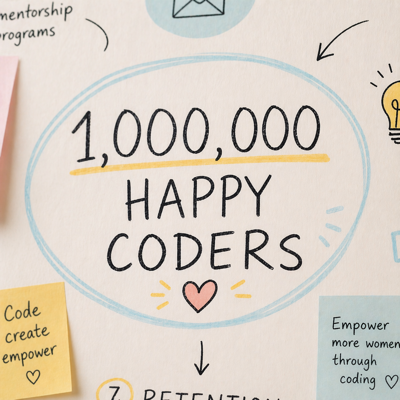
Real scenario: SheCodes is launching a new online course in 8 weeks.
"

What you're doing has the potential to impact millions. Having worked in a mission-driven company before, I know this is when I do my best work. There's no better motivator than helping people achieve their potential in life.

- Lucinda